





Table of Contents
- What You'll Need Before the Airport
- IATA Live Animal Regulations: What Inspectors Check
- How to Measure a Dog for a Travel Crate
- Airline-Approved Crate Labeling and Documentation
- Step-by-Step Dog Crate Airline Inspection Tips
- Pre-Flight Crate Acclimation and Travel Stress Reduction
- Common Inspection Failures and How to Fix Them
- Frequently Asked Questions
Last Updated: September 15, 2026
What You'll Need Before the Airport
A dog crate airline inspection fails most often because of missing paperwork, not a faulty crate. According to the International Air Transport Association's Live Animals Regulations, carriers assess every kennel against container, ventilation, and documentation requirements before it is accepted for travel. This guide from K&J Custom Dog Crates translates those rules into a practical pre-flight routine, so you can walk up to the counter knowing exactly what the agent will look for.
Before you leave home, assemble the following:
- A rigid crate sized correctly for your dog's standing height and turning radius
- Bolt-on hardware, including a rear airline rail where your carrier requires one
- Two attached food and water bowls, filled no more than a third full
- Absorbent bedding that will not shift during handling
- A live animal checklist and veterinary health certificate
- Identification labels on the top and at least one side
The checks below take about 20 minutes at home and prevent the most common gate rejections.

IATA Live Animal Regulations: What Inspectors Check
Inspectors verify six things: crate dimensions, ventilation, structural integrity, the locking mechanism, labeling, and documentation. Each is pass or fail, and a single failure can ground your dog.
The IATA Live Animals Regulations set the baseline that most carriers worldwide adopt, and individual airlines layer their own restrictions on top. That is why a crate marketed as "airline-approved" can still be refused: the approval is carrier-specific, not universal.
The inspection is visual and physical. An agent lifts the crate, presses on the door, checks that fasteners are bolt-on rather than snap-on, and looks for gaps a paw could slip through. Brachycephalic breeds face added scrutiny because of breathing risk in the cargo hold.
How to Measure a Dog for a Travel Crate
Measure your dog standing, not curled up. The crate must let it stand without its head touching the roof, turn around, and lie down fully extended.
Use this method:
- Measure height from floor to the top of the head, or to the ear tips for upright breeds.
- Measure length from the tip of the nose to the base of the tail.
- Measure width across the widest point of the chest or shoulders.
- Add 5-10 cm to the height and length so the dog can move naturally.
- Confirm the total crate dimensions fit your carrier's maximum for the cabin or baggage area.
A crate that is too small is a welfare problem and a compliance failure; an oversized one may exceed the aircraft's cargo hold limits. For powerful breeds that panic in confined spaces, a heavy-duty aluminum crate holds its shape where a wire kennel bends.
Airline-Approved Crate Labeling and Documentation
Airline-approved crate labeling means three pieces of information, attached where they survive handling: your name and contact number, your destination address, and a live animal sticker.
Attach labels to the top and one side, using permanent marker on a laminated card or a weatherproof adhesive label. Include a photo of your dog on the top label so ground staff can match the animal to the paperwork.
Your documentation folder should hold:
- The live animal checklist, completed and signed
- A veterinary health certificate dated within your carrier's required window
- Proof of rabies vaccination
- Any import permits for your destination
Keep a copy in your carry-on, not inside the crate. If the crate is separated from you, you still need the paperwork at the arrival desk.
Step-by-Step Dog Crate Airline Inspection Tips
Here are the dog crate airline inspection tips that matter most on the day. Run this sequence at home, then again at the counter. Structural items come first, because a failed latch makes every other check irrelevant.
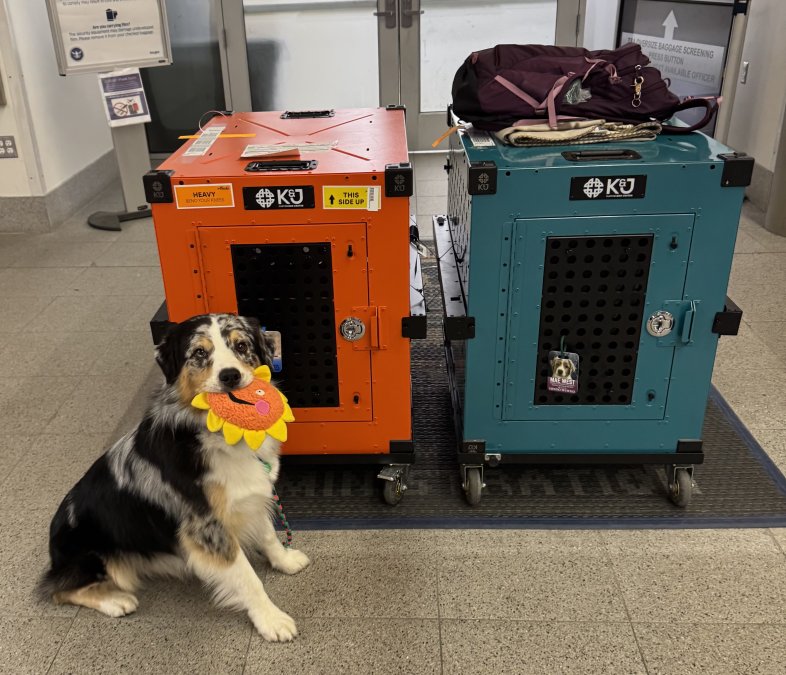
Stage 1, Structural pass (do this first, 5 minutes)
- Door and locking mechanism. Open and close the door twice. The latch must engage with an audible click and must not be workable from inside. Press inward on the closed door; if it flexes more than a few millimeters at the frame, the latch is not seating.
- Every fastener, by hand. Bolt-on hardware should be tight enough that you cannot rotate a bolt with finger pressure. If you can, tighten it with a wrench before leaving home, a bolt that loosens in the car will fail inspection at the counter.
- Ventilation on all four sides. Most carriers require openings on at least three sides, with the door counting as one. Run your fingers along each opening; if bedding, labels, or a chew guard block any side, clear it.
- Rear airline rail. If your carrier requires rear spacer rails, confirm they are installed and that the crate sits level on them. A missing rail is one of the few failures an agent can spot from across the counter.
Stage 2, Interior and consumables pass (5 minutes)

- Water bowl attachment. The bowl must be refillable from outside without opening the door. Fill it no more than a third full, a full bowl sloshes out during handling and soaks the bedding.
- Absorbent material. Line the floor with a material that stays flat under movement. Loose shavings shift and can block ventilation openings; a flat absorbent pad does not.
- Food bowl. Attach it, but do not fill it. Most carriers ask that food be withheld for several hours before departure to reduce motion sickness, and an empty attached bowl still satisfies the requirement.
Stage 3, Labeling and documentation pass (5 minutes)
- Labels on top and one side. Legible, with a current phone number. Include a photo of your dog on the top label so ground staff can match the animal to the paperwork.
- Documentation folder in your carry-on. Live animal checklist, veterinary health certificate, rabies proof, and any import permits. Never inside the crate, if the crate is separated from you, you still need the paperwork at the arrival desk.
Stage 4, The 60-second re-check at the counter
Handlers move crates repeatedly between check-in, the tarmac, and the hold. Before handing the crate over, repeat steps 1, 2, and 8 only, those three account for most counter-side rejections.
Printable pre-flight checklist
Copy this into a note on your phone or print it. Tick each line at home, then again at the counter.
Pre-Flight Crate Acclimation and Travel Stress Reduction
Common Inspection Failures and How to Fix Them
Failure |
Why It Happens |
Fix |
|---|---|---|
Snap-on fasteners |
Crate shipped with plastic latches |
Replace with bolt-on hardware |
Blocked ventilation |
Bedding or labels cover openings |
Clear all four sides |
Missing rear rail |
Older crate, new carrier rule |
Add a rear airline rail |
Illegible labels |
Marker faded or smudged |
Reprint on weatherproof card |
Failure 1, Rejection at the terminal, not at home
Failure 2, Breed-specific crate challenges
Failure 3, DIY modification that voids acceptance
Frequently Asked Questions
How do I ensure my dog crate passes an airline inspection?
Start by measuring your dog accurately and choosing a crate that meets IATA live animal regulations for ventilation, structural integrity, and size. Attach proper labeling with your contact details and destination. Secure all fasteners and bolt-on hardware before arrival. Bring the crate early to check-in so agents have time for a physical inspection. A crate with airline rails and a locking mechanism that cannot be opened from inside gives you the best chance of passing without delays.
Do airlines actually measure pet crates during check-in?
Yes, airlines do measure crates at check-in, especially for cargo hold travel. Agents verify that the crate is large enough for your dog to stand, turn around, and lie down naturally. They also check kennel dimensions against aircraft limitations. If your crate is too small or too large for the baggage area, it may be rejected. Measuring your dog at home and comparing against your airline's specific size limits prevents this problem.
What safety features must an airline-approved dog crate have?
An airline-approved crate needs secure fasteners, a locking mechanism that stays closed during turbulence, and ventilation on at least three sides. The door must be reinforced so a determined dog cannot push it open. Absorbent bedding material is required in case of accidents. Many airlines now require rear airline rails for cargo hold travel. A water bowl attachment that refills from outside without opening the door is also standard for long flights.
Are aluminum crates better for passing airline inspections?
Aluminum crates offer advantages for airline inspection because they resist bending and hold their shape under pressure. Chew-proof and escape-proof construction means the structural integrity stays intact throughout the journey. The bolt-on hardware and reinforced doors on aluminum models meet IATA standards more consistently than plastic carriers that can crack or warp during handling in the cargo hold.


